WHEN a learned person is imprisoned for his ideological beliefs, he has all the time in the world to reflect on his life, especially on events leading to his predicament.
By the time Jawaharlal Nehru found his true calling in life, he had been in and out of prison so many times that he almost treated the jail as his second home.
The once-future Prime Minister of India spent many months during one of his numerous jail terms in then British-controlled India writing this autobiography. The mood that emerges from this 623-page book is almost melancholic.
Born in the latter half of the 19th century and the only son of wealthy barrister Motilal Nehru, Jawaharlal was a descendant of the Kashmiri clan and a member of the Brahmin caste.
Even though Nehru modestly recounts his early education at England's Harrow and Cambridge University, the book impresses upon the reader that Nehru felt that he was indeed one of the few lucky ones amid the impoverished millions back home. Understandably, the major portion of the autobiography evolves around his political struggles and the effects of the accumulated years of incarceration on his family.
He shares his thoughts on Mahatma Gandhi with admirable candour. He discloses his doubts about the great Indian leader at certain junctures when Gandhi made decisions that did not seem to coincide with practical objectives.
This reflection and confession of thoughts and deeds cover a wide spectrum of Nehru's early checkered political career when he had to bear great physical discomfort and endure much personal hardship.
If the great Mahatma was the soul of India, then surely Nehru must be her conscience. It takes a man of great character to bare his heart and soul to the nation and the world, to expose his weaknesses and doubts about his own political beliefs and physical limitations. Yes, there were times when the beatings became so severe that even the steely resolve that was part of the Nehru persona began to buckle.
During the 1920s and early '30s, India was caught up in a massive, inexorable wave of nationalism. Nehru walked among the masses as one of the few leaders revered by people from all strata of society. He ate their food, stayed in their hovels and wore the kurta (local native attire) to drive home the message that he was there with them in spirit and in person.
For his courage of conviction and compassion for the people he had chosen to lead, the name Nehru was spoken with great reverence among the common folk, even till today. India should be proud that in her history there once strode a man named Jawaharlal Nehru.
If one desires to understand India, her people, and history, this book will serve as a great introduction. A study of India cannot be complete without learning about
Nehru the politician, the husband, the son and the voice of the Indian masses.
While this is not light reading, those who dare to walk along side with Nehru as he trudges down the long and winding path he once took will find the rewards enormously satisfying.
Thursday, February 23, 2006

A Course In Miracles - by Helen Schucman
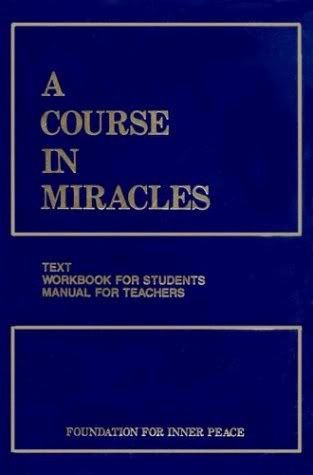
IF YOU are faced with a choice of reading only one book for the rest of your life, let it be this one. A Course In Miracles (ACIM) is certainly the most amazing book I have read in my entire life.
It is actually a three-in-one book. The fi rst volume is the Text; the second is Workbook for Students and the third, Manual for Teachers.
Originally, it was published separately in three parts, but ACIM - as it is generally called - has now been merged into one book.
This book was birthed under unusual circumstances. The writer is Helen Schucman, a research psychologist as well as an associate professor of medical psychology. Schucman referred to herself as the "scribe".
Schucman had made public that the writing in this book was through inner dictation. She said she was aided in the process by Dr William Thetford, who was a professor of medical psychology.
ACIM is a comprehensive self-study spiritual-thought system. It does not impose any special conditions on the part of the reader except a willingness to partake in its lessons.
In its introduction, it says: "This is a course in miracles. It is a required course. Only the time you take it is voluntary. Free will does not mean that you can establish the curriculum. It means only that you can elect what you want to take at a given time.
The course does not aim at
teaching the meaning of love, for that is beyond what can be taught. It does aim, however, at removing the blocks to the awareness of love's presence, which is your natural inheritance. The opposite of love is fear, but what is allencompassing can have no opposite." Even though this book is all about spirituality, the writer herself is a self-professed atheist.
Schucman said: "I do not believe what has been written but I do know the principles work." A strange statement about an otherwise astounding book.
ACIM was published in 1975 and has since been translated into nine other languages with another 11 in the translation process.
This book alters a person's perception of life in general. It teaches you to "see" beyond what is before your eyes. It makes you understand the link of all that exists and what can never die. The whole message of ACIM can be distilled into just a few lines. They are: "Nothing real can be threatened.
Nothing unreal exists. Herein lies the peace of God." ACIM changes your life if you allow it to. It alters an individual's sense of perception and transports you to another level of consciousness. If you have the discipline to follow the 365 lessons in the Workbook for Students, it will clear your mind, unlock your heart and free your soul to wander to its real home.
In its 30 years of existence, it has spread its message and lessons across the world. This book cannot be found in bookshops. It can only be obtained from its source, the Foundation For Inner Peace, through the Internet.
Thinking About The Unthinkable by Herman Kahn
HERMAN Kahn was a military strategist who played war games in the borderless battlefi eld of his mind. Noted to be one of the most brilliant minds of the 20th century, Kahn was an employee of the Rand Corporation in America in the volatile `50s and the rocking `60s.
It has been noted that Herman Kahn had no experience in actual warfare but his contributions as a systems theorist and military strategist at Rand thrust him onto the forefront of the Cold War between the Soviet Union and US in the 1950s and 1960s. Kahn's seminal work on thinking about the unthinkable had probably helped shape America's nuclear strategy for the next two generations.
Kahn was the only strategist at that time who dared to examine the brutal realities of a world gone mad. Thus was born the well-known doctrine of Mutual Assured Destruction or MAD. Kahn was also responsible for bringing to the world's attention, phrases like "overkill", and "massive retaliation".
Kahn had earlier gained prominence when he published an earlier work entitled On Thermonuclear War in 1961. That laid the groundwork for Thinking About The Unthinkable in 1962. This book is all about the
shocking possibilities and counter-measures if a nuclear war were to took place between USSR and the US. Kahn's argument for engaging in mental analysis of an extremely daunting subject was that "it wasn't immoral to think about these things; on the contrary - planning for nuclear contingencies in the event deterrence fails is the only responsible, prudent and moral cause".
To help readers and his detractors to emotionally comprehend the concepts of thermonuclear war, Kahn used anecdotal illustrations and "Gedanken" experiments. Gedanken is German for "thought", and a Gedanken experiment is an analytical tool in physics and philosophy. Its aim is to argue to a satisfying conclusion all the potential consequences of an intended experiment in accordance with the laws of nature, in this case, nuclear war.
Thinking About The Unthinkable is for those who want to know the outbreak scenario, earth shock, environmental problems, genetic effects, medical aftereffects and social and political changes concerning nuclear war.
Even though the grim subject and its related topics are unpalatable for most ordinary citizens, Kahn's thoughts and their relation to global political stability in the 21st century cannot be underestimated. A discussion of mass extermination of the human race is not exactly breakfast fodder, but it is definitely food for thought in the context of present political circumstances in parts of the Middle East and Asia in present day.
If mankind were to avert such an outcome or even to think of eliminating the factors that could lead to such a horrific situation, it is prudent that man must cultivate a deep understanding of the complete scenario. Herman Kahn has clearly provided us with some vital tools that would help in defusing such an explosive issue.
The Importance of Living by Lin Yu-tang
PUBLISHED in 1937, this book has found its way into the private libraries of book readers and collectors who consider this tome by Professor Lin Yutang as one of the most enlightening ever published before World War II.
It expounds the simple joys of living that are constantly overlooked by many of us. The answers to peace of mind and to live with a perpetual smile are found in the classic Chinese philosophy of looking for the extraordinary in the ordinary.
Lin has an easy way with English which he uses to communicates his philosophy of life with great finesse. With most books that touch on any philosophy of the gentler kind, understanding of the subject by the reader is crucial.
Lin's clarity of ideas is done with humour that is very much part of his persona. Thus, in a relaxed and easy manner, his ideas seem most logical and agreeable even to the most cynical among us. The writer was born on October 19, 1895, in Fujian, southeastern China. He obtained his bachelor's degree at the St. John's University in Shanghai. His academic excellence earned him a partial scholarship for a PhD programme at Harvard University.
However, he didn't complete his stay at Harvard and moved on to France and later Germany. It was in Germany where he completed his PhD course. Lin then went on to teach English literature at Peking University.
Lin Yutang's childhood memories of his mountainous hometown remained with him his entire life. Much of what he loved about country living was reflected in The Importance of Living.
Metaphorically, this book is like walking on the beach early in the morning and witnessing the splendour of dawn as light peeks over the distant mountain top. Lin has a knack of reminding us of what's really important in life.
Some of the most pleasurable and greatest moments of an individual's life are found in simple activities like hearing the rustling of the wind through the trees, or watching the rain sweeping gently across the land.
This book and his earlier work, My Country My People (1935), established Lin's reputation around the world. Lin once remarked that he was a man whose feet were firmly planted on the East while his head hovered in the West.
Throughout his life, one of his chief aims was to build a bridge over the cultural chasm between the West and the East. His fame stretched beyond the borders of his homeland and lasted longer than his lifespan of 81 years.
The following quotation from The Importance of Living reflects Lin's understanding of life and his countrymen: "One can learn such a lot and enjoy such a lot in 70 years, and three generations is a long, long time to see human follies and acquire human wisdom. Anyone who is wise and has lived long enough to witness the changes of fashion and morals and politics through the rise and fall of three generations should be perfectly satisfied to rise from his seat and go away saying `It was a
good show,' when the curtain falls."
A reader of this book will have the same feeling when he finishes it.
Monday, January 23, 2006
The Railway Man by Eric Lomax
PUBLISHER: BALLANTINE BOOKS
PRICE: RM48
SOME books leave readers with a feeling of exhilaration at its
conclusion. Other books inspire, encourage, motivate or even frighten
readers.
Then there are books that leave their readers in tears, and The Railway
Man is one such book. It is about a young Englishman who found himself in
Malaya just before the outbreak of the Second World War. His experiences
as a soldier and then as a prisoner of war in Malaya, Singapore and
Thailand left psychological scars so deep that it took almost half a
century to heal.
Eric Lomax's gut-wrenching story was written as a balm to heal his own
soul. Lomax was one of the tens of thousands of British and Australian
soldiers who found themselves living out the war years behind barbed wire.
In Lomax's case, his PoW experiences led him to work on the infamous
Burma-Siam Railway and then sent him straight to hell. The Death Railway
as it was called was responsible for the deaths of thousands of war
prisoners. The writer's survival from such an ordeal is in itself a
miracle. But the core of Lomax's horrifying wartime experiences is the
almost unbelievable torture by the Japanese Kempeitai. Beaten by the
Japanese military with pick-axe handles for hours until his arms and hips
were broken, Lomax miraculously survived, only to be later subjected to
several rounds of water torture. In the midst of all that unimaginable
pain, Lomax was denied the luxury of death.
He recounted that two of his army friends were also beaten in much the
same way. Their mangled bodies were left out in the hot sun for days.
Somehow they survived, much to the surprise of their torturers. However,
most of them eventually died but not Lomax, who returned to England, got
married shortly afterwards and settled down to a mundane career. But the
hell from which he escaped followed him. Decades later, he would wake up
in the middle of the night screaming. Each time, reliving the agonies of
prison torture and visions of friends dying horrible deaths.
Wondrously, this book is not about retribution but about forgiveness and
courage. Decades later when most of the world have forgotten about the
war, Lomax carried with him the image of one man who came to symbolise the
cruelty of the enemy. The enemy was Nagase Takashi, the interpreter who
was assigned to the Kanburi prison camp where Lomax was held. Lomax hated
his tormentor with a bitterness that turned him into a walking shadow of
fear and self-doubt.
Nagase was the enemy who was constantly in Lomax's presence when he was
questioned and tortured. Call it a miracle of fate, but the two men
emerged from the war, physically intact but victims of painful memories.
In his unbridled account of his PoW experiences, Eric Lomax has
unchained himself from a lifetime of pain, sorrow, misery and nightmares.
This book is as much about the healing power of forgiveness as it is about
the miracles of compassion and love. It is one of the most heart-rending
accounts of wartime experiences that I have ever read. It has blessed the
writer for finding the courage to bare his soul, thus making him whole and
it also blesses the reader who learns that forgiveness is the key to peace
of mind.
BASIC JAPANESE VOCABULARY AN EXPLANATION OF USAGE
AUTHOR: Toshiko Yamaguchi
PUBLISHER: Pelanduk Publications
PRICE: RM23
LEARNING a foreign language is the dream of most people. We all wish to
be able to speak Spanish, French, German or even Arabic fluently. However,
most of us also do not have the determination of a champion or the
tenacity of a world-class marathon runner.
This book by Toshiko Yamaguchi is a supplementary guide for those who
are in the initial stages of learning the Japanese language. If you have
no basic knowledge of the language, it's time to say "sayonara" to this
book now.
The author holds a PhD in linguistics. Her years of experience in
teaching Japanese to students in Singapore and Malaysia have helped her
understand the problems of learning the language among locals. Japanese
language students will be pleased to know that the book deals extensively
with the subtle differences between various Japanese words. This book has
seven chapters that elaborate on the seven characteristics of the
vocabulary. As in any other language, the nuances are hard to grasp by
novices. So many students make the mistake of using some words in
different situations, thinking the meaning is the same. That is not true.
Yamaguchi explains that many words have multiple meanings. Just like
Chinese characters, each word can convey a different meaning in a
different context. The trick of the trade, so to speak, is to learn the
useful phrases early at the elementary level. So one day if you happen to
be walking in downtown Tokyo, you may want to say "Anata wa eigo o
hanashimasu ka?" (Do you speak English?) to a stranger on the street. If
he replies "Hai, sukoshi hanashimasu" (Yes, I speak a little), then it's
your lucky day.
Those who already have a working knowledge of Mandarin will find it much
easier to master the Japanese language because of certain similarities.
Those who do not have this advantage may find it a bumpy road ahead. The
point is not to give up. This is where Yamaguchi's diligence will come to
play. She has expertly placed, side by side, the explanations in English-
to-Japanese words.
There are the glossary, grammar and answer sections to help students
understand the overall structure of the language. As with most challenging
tasks, everything begins at the most basic level. This guide will shine a
bright light on the path for those who wish to learn and speak the
Japanese language well. The explanations are simple enough to grasp and
important words are marked in bold. With Yamaguchi's well-structured
chapters and the student's perseverance, mastering the Japanese language
should not be too difficult.
Here are some phrases you may want to memorise in case you make an
unscheduled stopover in Japan sometime in the near future. They are "Sore
wa ikura desu ka?" (How much is it?), "Toire wa doko desu ka?" (Where is
the toilet?), "Iie, wakarimasen" (No, I don't understand) and "Tasukete!"
(help!).
The Master Plan To Success andrew carnegie
Publisher: Napoleon Hill Associates Creative Vision Sdn Bhd
ABOUT 100 years ago, a young journalist, Napoleon Hill, was assigned to interview a list of famous personalities. The year was 1908 and on top of his work list was Andrew Carnegie.
Carnegie was in his 70s at that time. He was the founder of the United States Steel Corporation. He was also one of the richest men in America. The great industrialist is famous for the Carnegie Public Libraries which are scattered throughout the world today.
During the interview, Carnegie said: "It's a shame that each new generation must find the way to success by trail and error when the principles are really clear-cut."
Carnegie then urged Hill to draw up a practical philosophy that the ordinary man in the street can use. He then sprung a surprise on Hill. He asked if the young man was willing to devote the next 20 years of his life to this monumental task.
The catch was the tycoon would not be funding the project. Hill would have to find his way to the so-called Rainbow's End. Except for the financial incidentals like the occasional pocket money and travel expenses, Hill was very much on his own.
In his lifelong quest, Hill interviewed, among others, John D.
Rockefeller, Theodore Roosevelt, William H. Taft, Woodrow Wilson, Thomas
Edison, Alexander Graham Bell, Henry Ford, George Eastman, F.W.
Woolworth, Charles M. Schwab and William Wrigley Jr.
This book was originally titled How To Raise Your Own Salary. It has 17
principles of success. All the wealthy and famous men whom Hill
interviewed over two decades had freely given their formulas of success
so that future generations the world over could benefit from their
accumulated experiences.
The 17 principles are Develop Definiteness of Purpose, Use the Master
Mind Principle, Develop An Attractive Personality, Employ Applied Faith,
Go The Extra Mile, Use Organised Individual Endeavour, Cultivate Creative
Vision, Exercise Self-Discipline, Organise Your Thinking, Learn From
Defeat, Seek Inspiration, Control Your Attention, Apply The Golden Rule,
Cooperate, Budget Your Time And Money, Make Health A Habit and Benefit
from Cosmic Habitforce.
This book is a treasure trove of some of the finest gems in life. If it
is at all possible, it should be made standard text in all Malaysian
schools at secondary level.
Its purpose is clearly to inculcate in Malaysian youths some of the
best values ever developed by masters who have walked the earth long
before many of us were born. The number of youths willing to absorb and
practise these principles is not as important as their awareness of these
values and virtues that can be adopted and developed by everyone.
The world has moved on since Hill's death on Nov 8, 1970. In his 87
years on earth, Hill wrote a number of significant books that have left
an indelible mark on many successful individuals who were fortunate
enough to read them. These books are Think and Grow Rich, Law of Success,
Napoleon Hill's Science of Success and Master Key To Riches.
Among these, of course, is The Master Plan To Success. It shall remain
one of Hill's most stirring personal statements on how to achieve success
in life. It is his great discovery after interviewing so many masterminds.
The entire project was destined to be Hill's work because those
historical figures lived during his time. It was also fated that he met
and talked to them.
This book is then the culmination of 20 years of hard work, from which
today we all are the beneficiaries.
After we have become successful, and lest we forget our humble
beginnings, Carnegie says: "Humility of the heart is the result of a true
understanding of man's relation to his Creator, plus the recognition that
the material blessings of life are a gift of the Creator for the common
good of all mankind."
BELIEVE AND ACHIEVE
By W. Clement Stone
Publisher: Napoleon Hill Associates Creative Sdn Bhd
FORTY-ONE years after Napoleon Hill's historic meeting with Andrew Carnegie the American steel industrialist, another man walked into Hill's life.
Clement Stone was 50 years old when he met Hill who was then 69 and semi-retired. Hill was enjoying the fruits of his labour from a lifetime of lecturing and writing. Stone was the head of his enormously successful insurance company called Combined.
The meeting between Hill and Stone took place in Chicago at a Kiwanis Club. The organiser thought it would be interesting to arrange the meeting of the two of the best minds in America. It triggered a collaboration of works that spanned over a decade.
They found in each other a common ground that success can be achieved if only a person believes in his own abilities and in his own potential to achieve success regardless of the odds stacked against him.
Their combined efforts were seen in a long series of "Positive Mental Attitude" lectures held all over America. One of the keys to the success of their long association was enthusiasm. To keep the zeal burning and alive in the hearts and minds of their audiences, Stone and Hill founded the magazine called Success Unlimited.
Stone's Believe And Achieve also has 17 principles, much like Hill's earlier work The Master Plan To Success. Many of the principles mirror Hill's success formula. However, Stone has given this book a more contemporary flavour.
Stone discusses case studies of Americans who rose from poverty to enjoy the lifestyle of the rich and famous, among them country singer Merle Haggard who emerged from San Quentin Prison to become one of America's best-loved singers; talk-show host Larry King who was fired from his job, sank deeply into debt and almost gave up on life until he decided to claw his way back to the top; and Carl Perkins, the man who overheard a boy telling his girlfriend at a dance party to "stay off his
suede shoes".
Perkins couldn't forget the conversation and later wrote the song Blue Suede Shoes that was made famous worldwide by Elvis Presley.
Stories like these give Believe And Achieve a very real touch of credibility that readers will find most endearing.
What Hill wrote about decades ago in his Master Plan to Success has been expanded and elaborated upon by Stone to suit modern times. The formula is still there. It has been finetuned and some minor touches have been added and adjustments made.
This book is a moral booster for those who may have been lamenting that life has often left them holding the short straw. Stone's self-help guide should be the "kick-in-the-behind" that procrastinators and laggards need urgently to propel them to the forefront of the rat race.
In the process, those who abide by Stone's principles will learn that it is much better to associate with those people who are optimistic and enthusiastic and it's often wiser to budget your time and money.
In the final chapter, Stone has this to say to his readers: "In order to attain any goal in life, you must first learn to recognize, relate, assimilate and apply principles from what you see, hear, read, think, or experience.
"When you read an inspirational, self-help book, for example, you will not receive any benefit from the words unless you study, understand, comprehend, and apply the principles it sets forth." There you have it, now you have no more excuses.
ENGLISH GRAMMAR FOR EVERYONE - MASTERING ENGLISH GRAMMAR
By Milon Nandy Publisher by Pelanduk Publications
THAT there are numerous books on the teaching of English in book stores is a fact. Many are not only good but also important for imparting lessons and tips towards mastering a language that is also probably the most relevant medium of communication today.
Milon Nandy's English Grammar For Everyone was first published in 1999. This is a revised edition, updated in keeping with the latest developments in the use of the English language in the 21st century.
Those of us who can speak and write English will no doubt think we have learnt all that could be learned about the language. This comprehensive self-study guide will surprise even the most learned among us that there are many aspects of the language that we have overlooked.
Truth be told, grammar is not exactly the favourite subject for many of us. It can be taxing on our attention span and it may even be confusing after a while, for those who have not dedicated their lives to becoming grammarians.
This book is all about grammar. It has been designed and written in a manner to be readerfriendly. So you may approach it without any fears of experiencing a sleeping-gas effect.
Those readers who went to school in the `50s and `60s would experience a dintjwill vu with explanations of abstract nouns, intransitive verbs, present perfect continuous tense and types of conjunctions.
Experts in English grammar are now a rare species. Those who have a natural inclination towards mastering grammar are shrinking in number because the language has gone through a process of evolution that has surprised many old timers.
However, this book is a little like drinking wine. Once, you know what you are drinking and how it has been processed and matured, you will appreciate it more. In this case, English grammar comes across as a challenge to those who desire to know more about the language. The fact that the standard of English language has been declining rather rapidly not only in this country but also in other English-speaking countries is cause for alarm.
Hence, it is appropriate that this book on mastering English grammar be found in those households that value the language as an important tool in the advancement of career in most professional fields.
Those who currently "speak no England" are strongly advised to purchase this wonderful book by Milon Nandy and make it their English language bible. Some familiarity with the contents will hold the reader in good stead in future years.
Sometime in the distant future, if you are in the company of about 30 people at a function and find yourself the only one who can speak grammatically-correct English without any unconscious lapses into local lingo like "shioklah" or "tak boleh tahan", you may just end up in the A-list of guests for the next big party.
Thinking Smart - You Are How You Think
Applying The Theory Of Constraints In Developing Thinking Skills
BY KHAW CHOON EAN
EVEN though this thinking guide can be read by anyone, regardless of
age, I believe it is primarily aimed at schoolchildren. Thinking has long
been considered a skill that is generally ignored by a large section of
society.
Anyone who has a tertiary education believes that he can think for
himself.
Unfortunately, that is not the case, otherwise society will not be beset by so many common problems that could have been solved with some common sense and a little bit of critical thinking.
Thus, it is apt that writer Khaw Choon Ean has taken upon herself to render unto a permanent form, her thoughts and experience with this Theory of Constraints. The moment an individual reaches the age of reason, problems whether perceived or real will begin to set in. Hence, there will always be problems pertaining to various aspects of life as we move through the various passages of life.
How we handle these problems will determine our level of self-confidence and maturity in adulthood. In this book, defining problems, making the right decisions and accepting responsibility are discussed openly and realistically.
The thinking tools applied in the context of teaching and learning are called the Cloud, the Branch and the Ambitious Target Tree. The discerning reader will realise after a while that there's a similarity between the tools used and mind-mapping as created by mind-master Tony Buzan.
However, the Theory of Constraints for Education has been tailor-made for schools since 2001. Today, the tools are being used in the teaching of civics education and social science subjects.
Writer Khaw, who is also an educationist and a trainer in sports, has used innovative ways to make her ideas clear to all concerned. She uses simple charts and diagrams to shed light on subjects that can sometimes become complicated issues.
Part of this TOC process involves total understanding of the subject matter and putting forth your thoughts in a logical manner. Hence, actions and ideas have to be explored thoroughly so as to envision the consequences of wrong decisions.
In the whole scheme of things, students who wish to make full use of the Theory of Constraints have to execute systemically and strategically their plans of action.
On first reading, the book may be perceived to be rather quite simple in its approach to the subject, but then thinking is always a simple process if you know all the rules of clear thinking.
Khaw has done a fine job of illustrating her ideas of thinking out-of-the-box and developing win-win solutions in a systematic manner.
The writer has had a long career in the field of education. Her experience in education began with the years in Universiti Sains Malaysia where she had exhibited enormous talents in various fields.
This book is but one of her many achievements in the field of education.
That she is dedicated and immensely creative is without a doubt. With this book, she has made another significant contribution to the development of young children in this country.
Parents who are concerned over their children's education should take a closer look at this book and its relevance to the maturity of young adults in their own homes.
Wednesday, December 21, 2005
Surfing the Himalayas by Frederick Lenz
LET'S get this straight at the outset - this is not based on a true story. It is a series of experiences by an American who went to Nepal for an adventure.
Frederick Lenz has admitted that it is a work of fiction and hopes it will be entertaining to the reader.
Having said that, Lenz spins a tale of Eastern mysticism and Western pragmatism having a head-on collision. When a person has the advantage of youth, the world looks like a gigantic playground every morning when the sun peeks over the mountain or perhaps the highest skyscraper, as the case might be.
Lenz is very much in love with the snow and he's even crazier about snowboarding. What could be more challenging than to blaze trails on the snow - covered slopes of the Himalayas and then return home to brag about it.
That's exactly what the author had intended to do, but destiny had other plans for him. Lenz's life on the mountains would have been more or less the same as the thousands of foreign backpackers who throng the huts, chalets and hotels of Kathmandu, Nepal, if not for a saffron-colour robed monk named Master Fwap.
At this point, the reader (if old enough) may think that he has stumbled across another Lobsang Rampa clone. Fortunately, here's where Lenz starts to get serious.
Master Fwap is more than just a passing stranger in the night. The first time the writer met him, he nearly collided with him while snowboarding down a slope. Their second encounter began with Master Fwap saying "Our meeting was fated, and your karma caused it to happen."
Putting all his cards on the table, so to speak, the monk identified himself as Master Fwap Sam-Dup. He's the last master of the Rae Chorze-Fwaz School of Tantric Mysticism and Buddhist Enlightment. At this juncture, the reader is apt to exclaim: "Ah phooey, and my grandmother is Wonder Woman!"
Luckily, my initial reaction was to humour the writer. Lenz has a gift of spinning a yarn but it is a tale filled with infinite possibilities, just like an episode of Star Trek.
Master Fwap, after having established a vise-like grip on the snowboarder's attention, begins to educate him on siddhas (miracles), chakras (mystical energy centers in the human aura) and samadhi (state of emptiness).
A word of caution before proceeding to read further: this book is filled with a lot of spiritual mumbo-jumbo which those who are not so inclined may discover while ambling along the chapters to be disagreeable to their calm disposition.
But if, by chance, it has caught your interest, it does become terribly fascinating. Frederick Lenz is not an urban roustabout who just happens to also be a fine storyteller; his credentials speak volumes. Lenz is a Phi Beta Kappa and a magna cum laude graduate of the University of Connecticut. His resume shows that he also has a PhD from the State University of New York.
However, the central character of Surfing the Himalayas is undoubtedly Master Fwap who constantly comes up with gems like "each person has a soul - an inner core of light and intelligence as vast as the 10 thousand worlds - whose true nature is emptiness, ecstasy and happiness" and "in deep meditation, when your thoughts have become silent, and your emotions are calm and at peace, you can travel into and experience the inner worlds and dimensions of light and perfection, and even experience nirvana itself."
It is not necessary that you be a Buddhist to enjoy this book. Your religious beliefs are your own but as someone once said: "A mind is like a parachute. It works best when it is open."
Hence, this book must be approached like so. Lenz's story is a splendid tale well-told. It is thoroughly enjoyable, captivating and packed with all that is wonderful and refreshing.
The Feminine Mystique by Betty Friedan
One of the hottest TV shows right now is Desperate Housewives, but about 42 years ago, Betty Friedan wrote a book about the faceless desperate housewives in America.
The book was an overnight sensation. It brought relief to many silent women who had for a long time sensed that there was something wrong with their lives.
Social activist Friedan, who studied psychology in university, realised that "the problem with no name" was eating away at the lives of American housewives.
More than four decades later, the book remains a talking point among women. From it, emerged the frustrations, hidden desires and secret wishes of all women in the Land of Stars and Stripes.
This book zeroes in quickly on the heart of the feminine mystique - the issue of women's identity crisis. The accepted practice that American women's life ambition was to be a housewife and a good mother to her children. It was only when Friedan - a pioneer feminist - asked them to, that some women found the courage to express their inner pain.
The Feminine Mystique is the fruit of a questionnaire Friedan conducted among 200 college mates at her 15th college reunion. The survey revealed what had been obvious to Friedan and many other women of her time. Most American housewives were desperately unhappy.
Magazines rejected Friedan's findings and she spent the next five years delving more deeply into the subject. The result - this treatise that shook a nation and sent ripples across the world.
This book shows that Friedan had done her homework and legwork and her findings more than proved her case.
Friedan echoes the sentiments of other eminent feminists like Germaine Greer and Gloria Steinem. The bottom line, as Friedan says, is that women have been trapped in societal roles created by community leaders - usually men - since time immemorial. After eons of conditioning and practice, even the smart ones yielded to this conformity without question.
In the closing chapters, Friedan admitted that there are no easy answers to the problem. The only advice she offers is: "First, she must unequivocally say 'no' to the housewife image.
"Second, women must recognise marriage for what it really is. To see it as the final fulfilment of their lives would be a disastrous perception."
Generations later, it is revealed that Betty Friedan's book has helped change the lives of American women forever.
Women heads of government (or State) like Sirimavo Bandaranaike (Sri Lanka), Indira Gandhi (India), Golda Meir (Israel), Margaret Thatcher (Britain), Khaleda Zia (Bangladesh), Kim Campbell (Canada), Hanna Suchocka (Poland), Janet Jagan (Guyana), Helen Clark (New Zealand), Luisa Dias Diogo (Mozambique), Angela Merket (Germany) and others are testimony that women worldwide have made considerable progress since The Feminine Mystique first appeared.
On the negative side, the feminine mystique still exists in numerous forms - some subtle - in many countries. Depending on culture, tradition and the make-up of their society, many women's roles have remained the same for centuries.
Though Friedan was referring specifically to American women, it is undeniable that this is one of the most important books of its time for women all over the world. It holds an exalted position in the feminists' hall of fame.
This seminal work - which Alvin Toffler, author of Future Shock, described as "the book that pulled the trigger on history" - still has much relevance. It carries the strong message that all women must be allowed to realise and maximise their fullest potential at every level of society.
The Female Eunuch by Germaine Greer
NEVER make a brilliant woman angry. Someone obviously did because in
1970, Germaine Greer came out with a book entitled The Female Eunuch.
It was an overnight success. All the women who had always wanted to be
liberated fi nally found their icon. Those men who caught a glimpse of
Greer were aghast. "Who's this creature?" they asked.
Born in Melbourne, Australia, in 1939, Greer was labelled as one of the
most powerful voices of feminism in the 20th century. Till today, this
professor of literature at Warwick University in Britain is a
controversial figure.
The Australian political journalist, Christine Wallace, who wrote a
biography of Germaine Greer described her as "hegemonic heterosexuality",
"anachronistic passivity", and "grooviness personifi ed".
In reply, Greer called her a "flesh-eating bacterium" and "dung-beetle".
This woman of socially-shocking proportions began her academic career back
in 1956 when she won a teaching scholarship. During her varsity years, she
acquired the nickname "Germainic Queer".
Life never became the same after she joined the Sydney Push, a bunch of
intellectual left-wingers who practised non-monogamy.
The six-footer Greer was a natural at academic pursuits as her peers
found out because, in 1963, she picked up an MA at the University of
Sydney.
Her sterling achievement gained her a Commonwealth scholarship that she
used to finance her PhD programme at the University of Cambridge. Five
years later, she accepted a lecturing post at the University of Warwick.
In The Female Eunuch, all the years of growing up as a woman restrained
by societal norms and restrictions allegedly created by man in general
manifested in expressions of anger and repressed frustrations.
Greer talks about the hostility of men towards women and how women were
conditioned to hate themselves from cradle to grave. She pounced on the
nuclear family system and suburban existence for enslaving women, thus
making them "eunuchs".
It was a most controversial conclusion reached by a feminist with a
brilliant academic background. The book triggered a runaway sale and, by
March 1971, it almost exhausted its second edition. Countries in other
parts of the developed world quickly took notice of The Female Eunuch and
it was soon published in eight languages.
In this landmark book, Greer's rallying cry was "subjugation". She
points an accusing fi nger at the Western concept of female sexuality
which she said made women ashamed of their bodies and sucked the joy of
life out of them. Any member of the male clan who has read this book will
be surprised that a woman can speak so frankly and in such strong terms.
The book is almost flamboyant in its intellectual rhetoric and nerve-
wrecking in its passionate arguments, especially to the men.
At best, Germaine Greer has done women worldwide a service by openly
revealing what have been their heart's deepest secrets but were socially
suppressed until it found expression in a proper avenue. At worst, she has
widened and deepened the misunderstanding between the roles of women and
men as cast by the Western society for centuries.
Today, the postulations and pronouncements of The Female Eunuch are no
longer an issue. Perhaps it is due to the groundwork laid down by
headstrong women like Greer and her admirers.
Whatever the personal opinions may be, this book was a wonderful read
three decades and five years ago, as it still is today. You may not agree
wholeheartedly with Greer but you certainly cannot help but admire her
intellectual depth and deep convictions.
A final recommendation: all women on the threshold of early adulthood
should spend some time with this book. All the young men, too, should read
it, if they want to be someone else's life partners of admirable social
intelligence and cheerful disposition.
Sunday, November 06, 2005
SWEET SAVAGE LOVE by Rosemary Rogers


ROSEMARY ROGERS is labelled as Queen of Historical Romance. Her novels are not to be taken lightly, not by her devoted readers, that is. I happen to be one of her fans. Miss Rogers has left a deep impression on me many years ago as a woman who knows her characters and the historical tapestry of her tales.
Clearly, her novels reveal that she has done some fair measure of research into breathing an air of authenticity into her stories.
From the breathtaking splendour of Paris ballrooms to the dusty sands of Mexico, Ginny Brandon was to meet her match in passion and desire in the form of Steve Morgan. Together they set the stage for one of the greatest love stories ever told by Rosemary Rogers.
Ginny is the stunningly attractive daughter of an American senator and her paramour is Steve, a soldier of fortune, in modern day parlance, a mercenary. Steve and Ginny will fight each other's attraction in the unpredictable and sometimes dangerous circumstances that prevail in the wild, wild West before they come to terms with love's paramount objective.
Sweet Savage Love is a novel that unchains your heart and frees it from the confines of self-imposed emotional restrictions. From Rosemary's imagination, you are free to roam and ride on her roller-coaster bandwagon of passion. It is a wonderful journey of love's unchained melody that will continue to haunt you long after you have put down the book.
It compells you to look at all desirable women from a new perspective. You may curse the day you lift the book and place it before your eyes because you have been a born-again romantic. Sweet Savage Love makes you want to protect and be gentle to the fairer gender. It softens your demeanor and checks your untamed desires towards all women.
Rosemary Rogers lifts her readers up on to a pedestal that forces them to look at love with eyes anew. She gently assuages your mental agonies over unrequited love and weakens your desire to run away from love.
I put this novel right on top among the top 10 romance novels I have read. It is majestic in its presentation; magnificent in its proclamation of love everlasting and prophetic in predicting that there's no place to hide from true love.
Read it and weep with joy.
Your Destiny
Saturday, November 05, 2005
SHANNA by Kathleen Woodiwiss

I REMEMBER the romance novel Shanna like it was yesterday. I read it a long time ago but it put me on the path to reading more novel of such ilk that it make my growing years rather fun.
For a long time, I was exposed to reading Jane Austen, Bronte sisters, and Georgette Heyer. They were interesting, informative and for the first two, literary.
Then came along Miss Woodiss. Now, she could really spun a tale.
Shanna is about a young girl of 21 who practically ran into the arms of a handsome, rugged stranger named Ruark.
Woodiwiss writes with such passion that it inflamed my heart. And I always thought that it was an exclusive emotion of women. Shanna is simply one of the best romance books I have ever read.
I was quite shocked when I first read it to find out that it was really so good. The historical background and other details that accompanied the story were so finely interwoven into the story that they were seamless.
Kathleen Woodiwiss got enormous respect from me after that novel. I believe I still have that book in my bookshelf somewhere. I couldn't bear the thought of giving it away. Hey, that was practically my first romance novel and it opened up my eyes to romance.
Man seldom like to admit they are romantic. It is taken that the romantic feeling is kind of sissy. I couldn't be more wrong. I learnt that fact later in life.
Basically, the short is like this: In the year of our lord 1749, a beautiful, young woman by the name of Shanna Trehern ran away from home because she didn't agree to an arranged marriage.
That man whom she was running away from was Ruark Beauchamp. The fact that he's a convict helped Shanna to attempt to get as far away from him as possible. They did actually got married but that was an early occurrence. Ruark was not so easily deterred because he pursued her all the way to the Caribbean.
And the romance of two strong-willed persons begins. The tug-of-way between obstinacy and love is an age-old feeling that governed the lives of man since time immemorial. Shanna is intelligent, fiery and passionate. Ruark is kind, slightly rough and domineering and also frightfully handsome.
So while they battle for their own individuality, love somehow intervenes and binds the two wayward hearts into one and set them ablaze with the eternal flame of desire.
Shanna is a novel of great emotional proportions. It is guaranteed to make the reader want to believe in love. Love is scorching, unpredictable but in the end, totally enjoyable.
Kathleen Woodiwiss has upped the ante on romance novels with her magnificent effort. She stands among some of the greatest romance writers of our times.
Find your destiny!
OUSTED - An Insider's Story of the Ties That Failed to Bind
AUTHOR: Patrick Keith
PUBLISHERS: Media Masters
THE history of Malaya and Singapore has been intertwined for centuries. People from both lands criss-crossed the border from the days of the beginning of the Malacca Sultanate and they regarded both lands as one.
In the later half of the 1950s, both Malaya and Singapore were pushing forward their national agendas after emerging victorious from bruising battles with the Communists. History has revealed that the leaders during that time perceived that a merger of Malaya, Singapore, Sabah, Sarawak and Brunei, would be a win-win solution for all concerned, though Brunei opted out at the 11th hour.
For Singapore, merger topped its agenda. Lee Kuan Yew of the People's Action Party was confi dent such a merger would be a political marriage with grand possibilities.
And so it came to pass in 1963, Malaya, Singapore, Sabah and Sarawak merged into one nation called Malaysia. However, in a short span of two years, unresolved differences of opinion between political leaders from both sides of the Causeway cast asunder the two key players.
Lee and his PAP colleagues who fought long and hard in that battle for merger, was aghast at Prime Minister Tunku Abdul Rahman's decision. The acrimony between the Alliance of Malaya and PAP of Singapore, which began acrimoniously almost immediately after Malaysia was formed, escalated until the separation in 1965.
Much has been written about the split, which shook Singapore more than it did Malaya. Now 40 years on, a journalist who worked for The Malay Mail and later The Straits Times, has written the story as he saw it back in those tumultuous days.
Ousted consists of three sections. The fi rst is Tunku Abdul Rahman's view of the separation. Singapore's perspective is discussed at length in the second section, and the third section presents Tan Siew Sin's side of the story. Tan was the president of the Malayan Chinese Association. The separation continues to be a touchy subject between the two countries and Ousted gives it an impartial treatment.
In his foreward, Patrick Keith says: "The time had come to attempt a different way of approaching the separation story". On that score, he is right. Forty years is far too long for such an important story to lie dormant. Ousted will serve as an interesting appendix to the study of regional politics by academics and political scientists from both sides of the border. Keith takes no sides in this political skirmish that left both nations with memories that have seldom been discussed, and definitely not fondly remembered.
The author has deliberately given no inkling of his personal opinion of the separation issue. All the key players in the Malaya-Singapore separation have had their say.
One is tempted to draw one's own conclusions after reading Ousted, but the story of Singapore and Malaysia continues to play on even today. Albeit without the angst and acrimony of the past.
The future of this region is deeply rooted in its history. Therefore, to acquire a deeper understanding of the political developments of Malaysia and Singapore, Ousted must be read objectively.
Click on this!
Thursday, October 20, 2005
My Penang by Lim Bee Chin
Penang is also known as the Pearl of the Orient. It is a place that is popular even among Malaysians. It has a long history of tradition and ties with England. It is allegedly the land of the Hokkien plus the nyonyas and babas. The food is great, their prices are below average. The sea, sun and beaches are beautiful. You have to experience it to know what I am telling you right now.
The Inside Guide To Where To Go And What To Eat
SOMETIMES things take place fortuitously, like this book dropping on my
lap just days before I embarked on a journey to that Pearl of the Orient.
It had been about three years since I last stepped foot on the island.
Yes, it has been much too long. This little book of 168 pages has all
the information that a visitor to the island would need. It has just
enough historical data to form the right impressions and the right amount
of geographical information to create the correct visual imagery of a
beautiful island in the sun.
The writer, even though she grew up in Sungai Petani, Kedah, has spent
enough years on the island to give an authoritative account of
present-day Penang. I believe Lim also has a large number of relatives
who are still residing on the island to educate her on the little known
facts about the island.
This is probably the first time I have ever picked up a book and
embarked on a journey to verify its facts. My five-day sojourn in Penang
was an eye-opener of sorts even though I had been a resident of the
island for a better part of eight years.
A foreigner who has not experienced Penang would certainly be intrigued
by the writer's personal knowledge of a place she loves and impressed by
the passion she feels for an island that has a long history with England.
The many colourful pictures of major landmarks are well displayed
throughout the book. The excellent write-up on the major races that form
Penang's population lends character and shine to the persona of the
"Pearl". Even though the dominant race is Chinese, other races like the
Malays and Indians have had strong influences on the culture and
traditions of Penang over the centuries.
Lim has correctly pointed out that Penang Malays have Bugis, Acehnese,
Javanese and Arabic origins. The Indians consist of two groups - Tamil
Hindus and Indian Muslims. The other minor Indian groups are Indian
Buddhists and Malayalees.
From this rich mix of races, coupled with their special dishes
originally from their homelands, sprung the now popular nasi kandar, from
which Penang has earned a fine reputation on a nationwide basis.
My journey to Penang was by road but there are other modes of
transportation to reach the island. The bridge has long overtaken the
ferries as the main route to the island. Those who work in certain parts
of the island and mainland still use the ferry as a matter of choice and
convenience. There are now fewer ferries plying the route compared with
the past.
Trishaws, as mentioned in the book, are still around. However, the
trishaw pedlars who are located mainly on Penang Road are frail and
mostly on the wrong side of middle-age. There had been occasions when I
have seen young foreign visitors riding the trishaws with the trishawmen
as passengers. This was mostly done on a lark - something to tell the
folks back home.
The information on the What To See chapter is accurate. All the major
attractions still exist in their heritage best but George Town is fast
losing its sparkle, according to local residents.
After 6pm, the shutters begin coming down. A shop owner said this
phenomenon started when the population started to expand on the outskirts
of the city, in places like Bayan Baru, Thean Teik estate, Gelugor and on
the mainland.
Twenty or 30 years ago, George Town was very much alive, even at 9pm.
These days, only specific areas come alive or are still awake at 10pm.
One of these places is the junction of Penang Road where the Continental
Hotel and Hotel Malaysia are located.
The row of brightly lit teh tarik stalls selling a variety of roti
canai draws the crowds and the foreign visitors.
The chapter on Where To Shop is a nugget of information for first-time
visitors.
Haggling is almost compulsory at most roadside stalls except for
shopping complexes. At present, one of the more popular spots for night
shopping is along Jalan Batu Ferringhi where the pasar malam or night
market seems to have become the "happening place".
One reason is because of the large number of foreigners staying at the
beach hotels along that stretch.
Personally, the crishme de la crishme in this book is the Where To Eat
chapter. Lim, like most true Penangnites, knows her food.
She has detailed all the places one can think of or has been to. I
believe she has covered most food places of repute.
It was because of this special chapter on food that I decided to check
out the various places that I know of and other places that I have
learned from this book.
It was a wonderful experience, filled with laughter and gluttony of
tolerable levels.
It is suspected that Malaysians who couldn't resist buying this book
will read the chapter on food first. It is safe to say that almost all
the stalls mentioned in the book are still around, whether or not they
have "changed hands" is another matter.
Readers should also take note of the treasure trove of details of where
to stay - from five-star hotels to budget accommodation.
Penang still has its fair share of backpackers. A number of these
people were seen venturing into the nooks and crannies of the island
during my stay there.
Penang will not be Penang without its various celebrations and
festivals. Writer Lim has again scored big on this aspect.
She has given thumb-nail accounts of 14 festivals that have become very
much part of the Penang mystique.
Lim Bee Chin should be complimented on her splendid effort with this
book. It is therefore not a surprise that the Penang Government and
Penang Tourist Guides Association have congratulated her on her literary
contribution.
There are other books on Penang but this one in particular deserves a
place on our bookshelves.
Notes from the United Nations by Abdullah Ahmad
This book is the compilation of writings by an elder statesman in Malaysia. His career is varied and extensive so he has earned the right to comment on a lot of subjects which may be beyond the scope of ordinary people. Malaysians in particular will find this book a good read on a lonely evening when the TV programmes are not so good.
Publisher: Times Edition
TAN Sri Abdullah Ahmad has a background that is the envy of many. His
almost half-century-long professional career has led him to the fields of
journalism, politics, foreign service and business. He has rubbed
shoulders with the high and mighty and also shared experiences with
prisoners.
To say that he has a checkered career is an understatement. It would be
more accurate to describe Abdullah as a person who has been up close and
personal with life's changing and challenging perspectives.
This is one of several books written by the former group editor-in-chief
of The New Straits Times Press. But Abdullah is better known for his years
as the political secretary of the late Prime Minister Tun Abdul Razak in
the early `70s.
His five years under the Internal Security Act have been well-documented
and his thoughts on this trying period are expressed rather succinctly in
some chapters.
The years of incarceration were a catharsis for a man who rose to great
heights professionally, to a position very close to the highest office in
the country.
Those episodes in his life are some of the most interesting pages in
this book. For example, he said: "After Tun Razak's death on January 14,
1976, important and influential colleagues told me that I would be
arrested, under some pretext or other, and they strongly advised me to
leave the country and return when the Umno leadership changed hands. I did
not heed their advice."
There are more than 70 `Notes' in this 368-page book. I found those
covered under the category "Close to Heart" the most captivating. His
early years with The Straits Times, which began in 1957, were something
that most of us journalists could identify with.
Those years of reporting coupled with feet-pounding-the-street
experience honed his writing skills and sharpened his eye for details. On
that aspect, he would probably have to thank Harry Miller, his KL boss at
that time, and other senior editorial executives at the newspaper.
Abdullah's remarkable memory for details has also made his latest
published work a treasure trove for students of Malaysian political
history. Revelations about the goings-on behind closed doors and insight
into the mindset of powerful figures certainly add colour to the hazy
pictures that students of history gleaned from books.
A case in point: "I once asked Tun Razak why he and most others were
wary of Kuan Yew. He said, `Dollah, you know that I never enjoyed talking
to anyone if I have to be on guard all the time. When you talk to Kuan
Yew, or play golf with him, you will have to be vigilant; otherwise you
will lose your shirt and putter to him.'"
From 1996 to 2000, Abdullah was assigned as Malaysian Special Envoy to
the United Nations. His years at the UN gave him the diplomatic licence to
observe many of the political machinations that went on behind tightly
shut doors of that august organisation.
It was there that his understanding of international politics took a
quantum leap and it opened his eyes, and now ours, as to how superpowers
shaped the destinies of smaller nations.
Abdullah's Notes from the United Nations will benefit those who have a
voracious appetite for political anecdotes and snippets. It will make you
sit up straighter in your chair and say silently, "Ah, I see, that was how
it happened".
Those of us who have lived through some of those eventful times that
Abdullah had an intimate knowledge of will be grateful that certain
important details left out of newspapers and history books have finally
surfaced in this book.
Politicians with Abdullah's kind of background should take note of this
literary effort and emulate his example. Our young nation needs more of
such writings that can contribute to a fuller understanding of the
political developments of the past decades.
But certainly, it takes a man of a certain character and strength to say
the things Abdullah has said in this book.
And on himself, Abdullah says: "In my time, I have seen a bit of life:
from Kok Lanas to royal palaces, presidential mansions and palatial
estates. I have also stayed in filthy police lock-ups. Moving from the
istana and kampung to police hovels was a small step for me. It was a
bittersweet experience. It made me a tougher man, more than I could have
believed possible myself."
The last word on Abdullah surely belongs to Tun Razak, Abdullah's mentor
and boss, when he said: "Dollah, you ni tiada perasaan takut langsung
(neither fear nor suspicion seem to have crossed your mind)."
Quick Guides to Mandarin, Bahasa Melayu and Shanghaiese
These two books are not exactly for bedside reading but if you are into languages and love learning and practising a few well chosen phrases in your next overseas trip, then perhaps you could find the time to dip into the pages of these two very practical books. Learning languages is a matter of interest and passion. Even a child can pick up some foreign phrases. So be a child again!!
Say It Right - A Quick Guide to Mandarin, Cantonese &
Shanghainese
Say It Right - A Quick Guide to Mandarin, Bahasa Melayu &
Bahasa Indonesia
Publisher: Times Editions - Marshall Cavendish
THE art of learning languages is a fascinating experience which many
desire to master but few ever achieve.
First, discipline is a prerequisite. Second, passion is a vital key.
Third, the importance of the right aids and tools can never be
overestimated.
Luckily, we are all living in an age where technology and intelligence
abound. The two books in this review are part of a learning process which
has benefited some of the more determined among us.
The two books have Mandarin as its main feature, the reason being that
Mandarin is the most widely-used language in the world. China has 1.3
billion people and Mandarin also opens many doors in Hong Kong, Macau,
Singapore, Malaysia and Indonesia.
Mandarin is known as putonghua in China and hua yu in Malaysia and
Singapore. In many parts of China, dialects still prevail. So is the case
in Singapore and Malaysia, but Mandarin is the bridge that links all gaps
created by dialects, hence its paramount importance.
The first volume encompasses Mandarin, Cantonese and Shanghainese. It
divides neatly into three categories the questions or remarks made under
the most common circumstances as experienced by travellers.
Let's take, as an example, the question "where is the restroom?". In
Mandarin, it is Wei sheng jian zai na li? Cantonese puts it as Sai sau gan
hai bin dou? And the Shanghainese would ask Ci su le gai sa di fang? Now
if you were in dire need of a restroom while sojourning in some remote
part of Shanghai, you would definitely need to make yourself understood.
This handy book may just add some relief to your life.
These guidebooks have neatly-organised chapters covering Basic Words,
Scenarios, At the Doctor's, Shopping and Social Settings. High marks are
given to its intelligent format, of which those who can converse in
Mandarin may find that their ability to make themselves understood with a
smattering of true Shanghainese can only elevate their status in the eyes
of the locals.
A close scrutiny of the various common expressions on popular topics
reveals that the Chinese, no matter what language or dialect they converse
in, are not that different after all. Any student of languages will tell
you that passion and interest lubricate the tongue and smoothen the
passage of communication.
In this region, notwithstanding the significant Chinese populations,
Bahasa Melayu and Bahasa Indonesia hold sway in Brunei, Indonesia and
Malaysia.
Indonesia has thousands of islands and about 300 languages and dialects.
In a nation of about 210 million, Bahasa Indonesia acts as a common
platform on which the diverse ethnic and linguistic groups communicate
their wishes and fulfil daily needs.
Bahasa Melayu and Bahasa Indonesia have been enriched over the centuries
by the adoption of Sanskrit, Arabic, Javanese and Dutch words. Thus today,
what may seem like "pure" is actually an amalgam of an evolutionary
linguistic process that started hundreds of years ago.
The second book of Say It Right opens avenues of communication that hold
endless surprises for those who love the spoken word. For example, if you
want to say "you have overcharged me", in Mandarin it is Ni duo suan wo
le. Bahasa Melayu puts it as Awak terlebih meminta bayaran dari saya. In
Bahasa Indonesia, it is Anda kelebihan menagih saya.
Both books are compact-sized and they can easily be tucked into your
hand luggage. All possible scenarios conceivable for any well-travelled
person are illustrated.
There's nothing more frustrating than not knowing how to tell the
person manning the counter that you are looking for an item for your wife.
Your near-zero knowledge of the local dialect results in the salesperson
staring at you as if you have just stepped off a space ship. Sign language
can only go so far.
If you want to learn more about the languages that have forged and still
form a common bond in Southeast Asia, then these two volumes of Say It
Right should be part of your travelling items.
Read, memorise, absorb and practise. Knowledge is now literally at your
fingertips. That's the fun part of travelling and learning.
Seeds of Greatness by Denis Waitley
There are motivational books in all book shops but not all can stir your soul and warm your heart. This is one of those special ones that can do both to you. Seeds of Greatness is for those people who think that if you want to be super successful and enormously popular, you need to be born with special genes. Rubbish, I say!
Read this book and be enlightened. Light is now shining on the path you walk.
Seeds of Greatness - The 10 best-kept secrets of total success
Brolga Publishing Pty Ltd
SOMETIMES in life, one is fortunate enough to come across a good book
whereby reading it turns out to be a life-altering experience. Seeds of
Greatness was my personal serendipitous encounter.
Even though the book was first published 21 years ago, its message
continues to be relevant, especially in these times.
Writer Denis Waitley is a behavioural scientist who has taught top
corporate executives and coached Olympic and professional athletes as well
as astronauts. He has mixed and learnt from the best and the most
successful.
This book is the culmination of a lifetime of learning. In between the
covers lie the common facts along with seldom learnt or practised secrets
that make up a successful life.
Norman Vincent Peale, author of the very successful Positive Thinking
series of books, said: "Seeds of Greatness is one of those rare books that
can help to make anybody's life greater."
As Olympic gold medal winner Wilma Rudolph remarked: "From the day I met
Dr Waitley, he has been my source of inspiration, and I feel honoured to
be included in his book. In my sad or low moments, I think of (him) and I
smile."
There are 10 chapters, each allotted to one of the 10 "seeds". These are
the Seed of Self-Esteem, the Seed of Creativity, the Seed of
Responsibility, the Seed of Wisdom, the Seed of Purpose, the Seed of
Communication, the Seed of Faith, the Seed of Adaptability, the Seed of
Perseverance and the Seed of Perspective.
Waitley's seminal work has been revised and updated over the years but
the message remains the same - that each one of us can be successful,
regardless of our background, race or creed.
Greatness is our birthright. It is always within our reach. The seeds
which Waitley talks about could perhaps be some of the advice which our
parents had given us while we were growing up. Like most teenagers, we are
not very good at listening. Now, someone has gathered all these seeds of
wisdom and neatly packaged it for our convenience, growth and personal
development.
Waitley has made it all quite palatable by recounting anecdotes of those
who have fallen and risen to greater heights. The book talks of ordinary
people striving, struggling, persevering and never giving up. It is an old
story often told to a shrinking audience because people are always
wandering about and looking for answers in the wrong places.
One of the facts highlighted is that "60 per cent of our fears are
totally unwarranted; 20 per cent are in the past and out of our control,
and 10 per cent are so petty that they won't make any difference at all."
Apparently only four or five per cent of the last 10 per cent of our
fears are justifiably real and these we can't do anything about. The
remaining percentage then are the real fears which we can solve.
With that kind of logical reasoning, Waitley leads the reader down the
path to tranquillity and visions of greatness.
Waitley's magnum opus should be digested slowly. Allow the "seeds" to
germinate in your mind, nurture them and watch them grow. At the end of
the book, one begins to realise that greatness is much akin to a walk in
the park.
We all have it in us - the seeds of greatness. The mind is the ground on
which these seeds are sown. If the mind harbours only negative thoughts,
then it fails to provide a fertile soil for these seeds to grow.
And the heart is the air which nurtures the greatness that emerges from
the seeds. With Waitley's guidance, nobody should be left behind in the
journey towards success.
Now's the time to plant the seeds of greatness in the garden of your
mind, and Denis Waitley is the right person to seek advice from.
Subscribe to:
Posts (Atom)
